How the Ladle Became a Fixture of the Shared Meal
The history of the ladle follows changing pots, serving customs, and materials, explaining how this simple tool became familiar at stove and table.
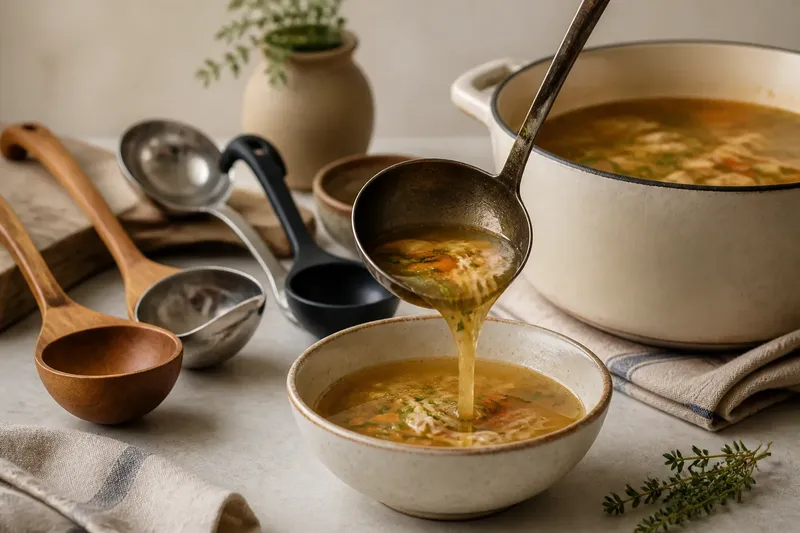
How did the ladle become a fixture of the shared meal? The history of the ladle is not a neat story of one inventor, but of a useful form adapted to different foods, vessels, and ways of serving. A deep cup can lift broth from a pot; a handle carries it to a bowl without asking anyone to tip the pot toward the table.
Early ladles followed the shape of the vessel
Before standardized kitchenware, cooks relied on vessels and utensils made from materials available to them. A scoop with a hollowed bowl and a handle was a straightforward answer to a recurring problem: how to transfer liquid from a deep container without using the container itself. The form could be made in wood or metal, among other materials, and varied with local craft and household practice.
There is no single design that explains every historical ladle. The size and curve of the bowl, the angle of the handle, and the material all depended on what the utensil had to reach and carry. A small scoop suited a narrow vessel; a larger cup could serve a pot of broth. The underlying task remained recognizable even as the details changed.
Shared pots gave the ladle a place at the table
In meals served from a common pot or bowl, a ladle offered a simple sequence: lift, pour, return. The tool could move soup, porridge, sauce, or another liquid-rich dish from a cooking vessel into individual bowls. That made the utensil useful both in the kitchen and during service, though household customs differed over whether a host or diners handled the serving.
The ladle also suited foods that were difficult to divide with a flat spoon. Its hollow bowl could contain liquid along with soft pieces, while its handle let the server reach into a deep vessel. It did not dictate how a meal was shared; it made one form of sharing easier to manage.
Changing materials altered the feel, not the basic task
As household goods and manufacturing practices changed, ladles appeared in a wider assortment of materials and finishes. Wood, metal, and later heat-resistant plastics each brought different handling and care considerations. Those differences depend on the particular product: a wooden handle may need different care from a one-piece metal utensil, and cookware makers may advise against certain tools on delicate surfaces.
Metal can feel sturdy, but its temperature and suitability depend on its design and use. Wood may be comfortable in the hand, though it can retain stains or odors depending on its finish and care. Silicone and other heat-resistant materials vary in firmness and construction. The material alone does not settle whether a ladle suits a pot or a dishwasher; product directions and cookware guidance matter.
When a ladle is used with a coated pan, follow the pan maker’s advice about utensils. For cleaning, follow the ladle’s care label rather than assuming every piece of the same material is treated alike.
Design details reflect changing kitchen habits
Modern ladles may have a pouring lip, a hooked handle, a hanging hole, or a marked bowl. Each feature responds to a particular use. A lip can help direct thin liquid; a hook can keep the utensil from slipping into a pot; a mark can aid repeatable portions when a recipe calls for them.
These variations do not replace the ladle’s central form. They refine how it meets a pot, bowl, or serving routine. A deep bowl remains helpful for broth, while a broader one can carry more substantial stew. The design makes most sense when read beside the food and vessel it serves.
What readers still ask about ladles?
What is the history of the ladle?
The ladle developed as a practical scoop for transferring liquid and soft foods from deeper vessels. Its precise forms and materials varied across households and craft traditions, so its history is better understood as adaptation than as a single invention.
Why does a ladle have a deep bowl?
A hollow bowl contains liquid during the lift from pot to dish. It can also carry soft pieces with broth or sauce, which a flat spoon may not hold as securely.
How did ladles become part of serving a meal?
A ladle lets someone portion food from a shared vessel without moving or tipping that vessel. In some settings the host serves; in others, diners pass or use the utensil themselves.
Are all ladles suitable for every pot?
No. Material, edge shape, and construction affect how a ladle interacts with cookware, and product guidance can differ. Check the cookware and utensil instructions, especially for coated surfaces.
A familiar form keeps adapting to the meal
The history of the ladle is visible in its continued range: a plain wooden scoop, a polished metal serving utensil, or a heat-resistant tool designed for a particular pot. The object stays recognizable because its central job has not changed, even as materials and table customs have.
That history is easiest to notice at the moment of service: one vessel holds the meal, another receives it, and the ladle bridges the two. Its quiet usefulness is not a mystery. It is a small piece of kitchen history still doing its original work.